Tone of voice guidelines: practical templates for UK teams
Unlock effective communication with our tone of voice guidelines. Equip your team with templates for consistency and clarity across all channels.

Tone of voice guidelines: practical templates for UK teams
Usable tone of voice guidelines do one thing well: they give every writer in your organisation a clear, repeatable answer to “does this sound like us?” A practical guide centres on three to five stable personality traits, each with a definition, concrete “sounds like” examples, and explicit “does not sound like” guardrails. Beyond the traits, it needs a channel tone map, a vocabulary list, approval boundaries, and at least one before/after example per major channel.
Here is what a complete set of guidelines should contain:
Three to five personality traits with definitions and example lines
A channel tone map covering web, email, social, ads and support
Vocabulary rules: preferred words, words to avoid, acronym and punctuation conventions
Approval boundaries: what writers can publish without sign-off and what needs review
Before/after examples for the highest-frequency writing tasks
Your concrete next step: within 48 hours, collect ten to fifteen pieces of existing copy from across your channels and score each one against a simple three-point scale (on-brand, borderline, off-brand). That quick audit tells you where the gaps are before you write a single guideline.
Table of Contents
What are tone of voice guidelines, exactly?
Why does tone of voice matter for your business?
What must every practical tone of voice guideline include?
How do you build tone of voice guidelines from scratch?
How should tone change across different channels?
Plain English, accessibility and inclusive language for UK audiences
How do you embed tone of voice into daily workflows?
Your one-page writer’s checklist and copy templates
How do you measure tone consistency and keep guidelines current?
What causes tone drift and how do you fix it?
How Brands & Co built tone of voice for a client: a case study
Key takeaways
Why empathy is the only honest starting point for tone decisions
Brands & Co can build your tone of voice guidelines
Useful sources for further reading
What are tone of voice guidelines, exactly?
Tone of voice is how your brand sounds in words. Not what you say, but how you say it. It sits inside a broader brand system alongside visual identity and positioning, but it is distinct from both.
Three terms that often get conflated:
Brand values are the beliefs your organisation holds (“we believe in plain dealing”). They inform voice but are not the same thing.
Brand voice is your stable, consistent personality in language. It does not change whether you are writing a homepage or a legal disclaimer.
Tone is the situational adjustment you make within that voice. A crisis statement and a social post share the same voice but carry very different emotional weight.
Your tone of voice documentation should cover voice traits, tone adjustments by situation, vocabulary rules and channel examples. It should not duplicate your positioning statement, your visual identity guide or your messaging hierarchy (though it should reference them). Voice should be stable while tone is mapped situationally, with separate guidance for high-stakes communications (regulatory notices, crisis statements) and low-stakes ones (social posts, routine emails).
A short illustration:
Voice (stable) | Tone (situational) | |
|---|---|---|
Homepage | Confident, direct | Warm and inviting |
Error message | Confident, direct | Calm and reassuring |
Social post | Confident, direct | Light, conversational |
Legal notice | Confident, direct | Precise, measured |

The voice column never changes. The tone column does.
Why does tone of voice matter for your business?
Treating tone of voice as a core business asset rather than a marketing nicety is the right frame. Brand voice is as important as visual assets and should be resourced accordingly, particularly in B2B contexts where written communication carries most of the relationship weight.
The commercial case is straightforward. Consistent language reduces cognitive load for readers, which means they spend less effort understanding you and more attention on what you are actually offering. That translates into better conversion rates, fewer support queries caused by confusing copy and stronger recall. When every touchpoint sounds like the same organisation, brand consistency compounds over time into genuine trust.
For UK audiences specifically, plain English is not just a stylistic preference. GOV.UK’s content and publishing guidance sets a clear standard: write for your reader, not your organisation, use active voice and avoid jargon. Audiences across the UK have been conditioned by public-sector digital services to expect clarity. When your brand delivers it, you signal competence. When you do not, readers notice.
Accessibility is part of the same argument. Clear, plain language benefits readers using screen readers, those with cognitive differences and those for whom English is a second language. In a multicultural market like the UK, that is a significant proportion of your audience.
What must every practical tone of voice guideline include?
A practical voice guide centres on three to five stable personality traits, each with a definition, concrete “sounds like” examples and explicit “does not sound like” guardrails. The guardrails matter as much as the aspirational descriptions. Friendly without a guardrail becomes unprofessional. Confident without one becomes arrogant.
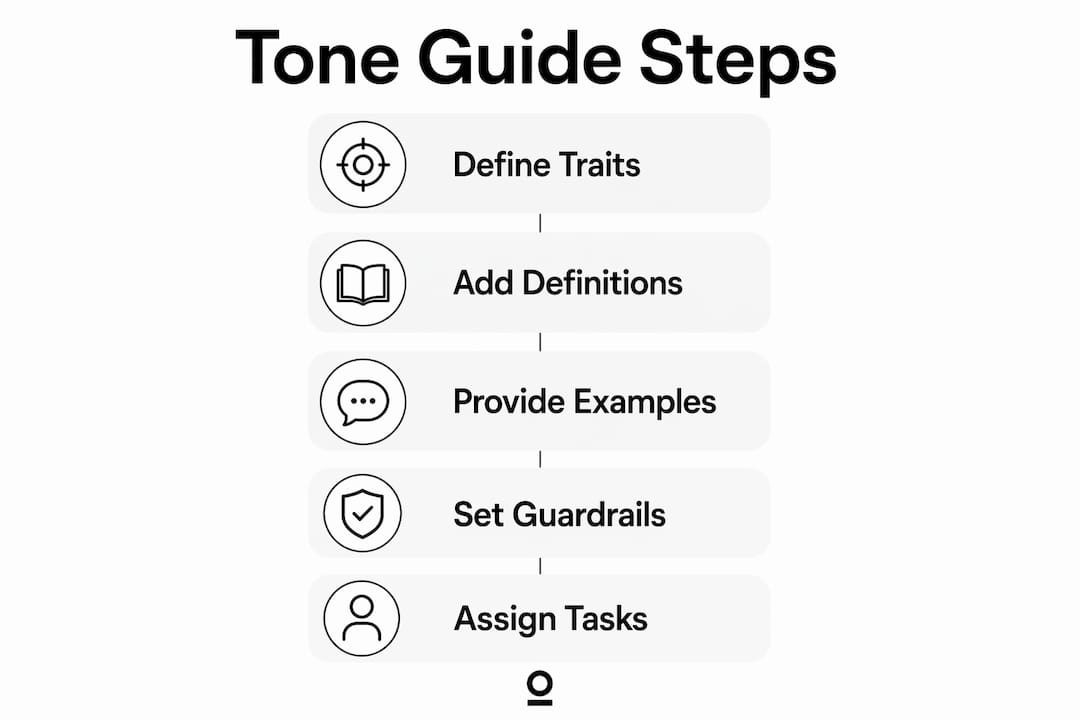
The trait table: your core template
Copy this structure and fill in your own brand’s traits:
Trait | Definition | Sounds like | Does not sound like |
|---|---|---|---|
Clear | We say what we mean in the fewest words possible. | “Your invoice is due soon.” | “Please be advised that the aforementioned payment falls due on the date specified herein.” |
Human | We write to people, not at them. Direct address, no corporate distance. | “You can cancel any time, no questions asked.” | “Cancellation requests may be submitted via the designated portal.” |
Confident | We state things plainly. No hedging, no over-qualifying. | “This is the right approach for most growing teams.” | “It could potentially be argued that this approach may suit some organisations.” |
Warm | We acknowledge the reader’s situation before we solve it. | “Moving supplier is a pain. Here is how we make it simple.” | “Our onboarding process has been designed to facilitate a smooth transition.” |
Honest | We do not oversell. We say what something does and what it does not. | “This works best for teams of ten or more.” | “The ultimate solution for every business, at any stage.” |
Vocabulary and phrasing rules sit alongside the trait table. List:
Preferred words (e.g. “use” not “utilise”, “get” not “obtain”, “help” not “facilitate”)
Words to avoid (jargon specific to your sector, filler phrases, passive constructions)
Acronym rules (spell out on first use, then abbreviate; avoid internal acronyms in customer-facing copy)
Punctuation preferences (Oxford comma yes/no, em dash usage, sentence length targets)
Messaging hierarchy tells writers what to lead with. A practical order: customer problem first, then your value proposition, then differentiators, then proof, then call to action. This stops writers leading with features when they should be leading with outcomes.
Pro Tip: Make traits operational by attaching them to real tasks. Instead of “we are warm”, write “when opening a support email, acknowledge the customer’s frustration in the first sentence before explaining the solution.” Aspirational adjectives stay abstract; task-level instructions get used.
How do you build tone of voice guidelines from scratch?
The process runs in four stages: audit, define, validate, publish. Here is a numbered checklist you can follow immediately.
Collect your sample. Pull ten to fifteen pieces of existing copy from at least four channels (website, email, social, support). Include both good and bad examples.
Score each piece. Use three dimensions: does it sound like your brand, is it clear, is it appropriate for the channel? Score 1–3 on each. Flag outliers.
Map the gaps. Where does your copy consistently fall short? Over-formal? Inconsistent register? Missing warmth? These gaps become your first trait priorities.
Run a stakeholder workshop. Invite brand, marketing, product, customer service and at least one senior leader. Two hours is enough. Use the first 30 minutes to share audit findings, the next 60 to agree on three to five traits, and the final 30 to draft example lines together.
Draft the guide. Keep it concise and place the most-used sections first: traits, tone by channel, vocabulary. Aim for a document a new writer can read in under 20 minutes.
Validate with real copy. Take five pieces of live copy and rewrite them using the draft guide. If the rewrites feel right to the team, the guide works. If they feel forced, revisit the traits.
Assign an owner and a review trigger. One person is responsible for the guide. Reviews happen when you launch a new product, enter a new market or receive consistent feedback that something feels off.
Publish where teams already work. A wiki page or intranet entry beats a PDF. The most common failure is an abstract guide that teams do not use; embedding it in content briefs and CMS templates is what makes it stick.
Workshop agenda (two hours)
0:00–0:30: Share audit findings, agree on the problem
0:30–1:30: Trait definition exercise (small groups, then share back)
1:30–2:00: Draft example lines and guardrails, agree on next steps
Roles to invite: brand or marketing lead (facilitator), copywriter or content manager, customer service lead, product manager, one senior sponsor.
How should tone change across different channels?
Each channel carries a different emotional contract with the reader. Your voice stays constant; the intensity and register shift. Map tone across common scenarios and give each one an emotional goal, a recommended tone and a caution.
Channel map and tone table
Channel | Emotional goal | Recommended tone | Caution |
|---|---|---|---|
Homepage | Confidence and invitation | Warm, direct, benefit-led | Avoid hype; UK readers distrust superlatives |
Product pages | Clarity and desire | Precise, benefit-focused | Do not bury the key fact in a paragraph |
Blog / editorial | Authority and usefulness | Conversational, expert | Do not slip into lecture mode |
Email (marketing) | Relevance and action | Personal, direct | Avoid subject lines that feel like clickbait |
Email (transactional) | Reassurance | Clear, calm | Never use marketing language in a receipt |
Social (LinkedIn) | Professional credibility | Thoughtful, grounded | Avoid corporate jargon; LinkedIn readers scroll fast |
Social (Instagram) | Personality and community | Light, visual, human | Emoji use: one or two maximum, never in B2B posts |
Support / help | Resolution and calm | Empathetic, precise | Never sound defensive or dismissive |
Error messages / UI | Reassurance | Calm, helpful, brief | Avoid technical language; never blame the user |
Ads | Attention and action | Bold, concise | No false urgency; UK audiences are sceptical |
Include platform-specific guidance because each channel carries different reader expectations. A LinkedIn post that works will feel stiff on Instagram. A support reply that works will feel cold on a homepage.
Before/after examples by channel
Homepage headline
Before: “We provide integrated solutions for modern business challenges.”
After: “We help growing businesses sound like themselves, at every touchpoint.”
Email subject line
Before: “Important update regarding your account”
After: “Your account: one thing has changed”
Support reply opening
Before: “We have received your query and will endeavour to respond within five working days.”
After: “Thanks for getting in touch. We have picked this up and will come back to you by [date].”
Error message
Before: “Error 404: The requested resource could not be located.”
After: “We can’t find that page. Try the homepage or search for what you need.”
Social post (LinkedIn)
Before: “Our latest whitepaper explores key trends in B2B communications strategy.”
After: “Most B2B brands sound the same. Here is why that is a problem, and what to do about it.”
Quick rules by channel: keep sentences under 20 words on social; use contractions freely in email and social, sparingly in legal or compliance copy; avoid emoji in B2B contexts unless your brand explicitly uses them; match the formality register to the platform’s dominant user behaviour.
Plain English, accessibility and inclusive language for UK audiences
Plain English is not dumbing down. It is respecting your reader’s time. The GOV.UK content standard is the clearest benchmark available for UK communicators: write for the reading age of your audience, use active voice, address the reader directly and cut words that do not earn their place.
Plain English rules
Target sentences of 15–20 words on average. Nothing over 25 words without a very good reason.
Use active voice: “We reviewed your application” not “Your application has been reviewed.”
Address the reader as “you.” Avoid “the customer”, “users” or “clients” in copy directed at a person.
Cut filler: “in order to” becomes “to”; “at this point in time” becomes “now”; “utilise” becomes “use.”
One idea per sentence. One topic per paragraph.
Accessibility checkpoints
Write descriptive link text: “read our pricing guide” not “click here.”
Use headings to signal structure, not just to break up visual space.
Write alt text that describes the image’s content and purpose, not just its appearance.
Avoid directional instructions (“see the diagram on the right”) that do not work for screen-reader users.
Test readability with a tool such as Hemingway Editor. Aim for a reading ease score that suits your audience.
Inclusive language and UK-specific considerations
The UK is a genuinely diverse market. Scotland, Wales and Northern Ireland each carry distinct cultural registers, and a phrase that reads as natural in London may feel imported or tone-deaf in Cardiff or Belfast. A few practical rules:
Avoid idioms that assume a single regional experience (“as English as fish and chips” excludes most of your UK audience).
Use the language your audience uses to describe themselves. GOV.UK’s guidance on writing about ethnicity is the clearest UK reference for respectful, accurate terminology.
Avoid gendered job titles where a neutral term exists (“chair” not “chairman”, “firefighter” not “fireman”).
Do not assume a single cultural reference point for humour, idiom or example. What lands in one community may alienate another.
For multilingual audiences, keep sentence structure simple and avoid idioms that do not translate.
Readability target: aim for a Flesch Reading Ease score of 60–70 for general audiences, 50–60 for professional or technical content.
How do you embed tone of voice into daily workflows?
Publishing a guide is the easy part. Getting a team of twenty writers to use it consistently is the real work. Publish the guide where teams already work, elect a tone champion, embed it into onboarding and schedule reviews triggered by business events.
Role matrix
Guide owner (usually brand or content lead): maintains the document, approves updates, resolves disputes.
Tone champion (one per team or department): the go-to person for day-to-day questions, runs writing clinics.
Approvers (legal, compliance, senior comms): sign off on regulated claims, crisis communications and anything with legal exposure.
Contributors (all writers): follow the guide, flag anomalies, suggest updates via the owner.
Training plan
Induction session (60 minutes): new hires read the guide, complete a short rewrite exercise, ask questions.
Writing clinic (monthly, 30 minutes): the tone champion shares two or three real examples, the group rewrites them together.
Refresher (annually or after a major brand update): full team session to review changes and re-align.
Tooling and integrations
Store the guide in your intranet or wiki, not a PDF. A static PDF becomes outdated and invisible. Connect the guide to your content brief template so writers see the relevant channel rules before they start. If your team uses AI writing tools, add prompt guardrails and QA criteria so automated outputs stay on brand. A simple prompt prefix (“Write in a clear, direct, warm tone. Avoid jargon. Use active voice. Address the reader as ‘you’.”) reduces drift significantly.
Approval boundaries
Not everything needs sign-off. A clear boundary saves time and removes bottlenecks:
Writers can publish without approval: social posts, blog introductions, routine emails, product descriptions following the template.
Tone champion review required: new campaign copy, any copy that introduces a new claim or tone register.
Legal/compliance sign-off required: regulated claims (financial, medical, legal), crisis communications, anything referencing a third party by name.
Your one-page writer’s checklist and copy templates
Pin this to your brief or content management system.
Writer’s checklist
[ ] Does this copy use one of our defined personality traits in every paragraph?
[ ] Is every sentence under 25 words?
[ ] Have I used active voice throughout?
[ ] Have I addressed the reader as “you”?
[ ] Have I avoided jargon and internal acronyms?
[ ] Is the tone appropriate for this specific channel?
[ ] Have I included a clear, single call to action?
[ ] Is the link text descriptive (not “click here”)?
[ ] Does this require legal or compliance review?
[ ] Has the tone champion or guide owner seen this if it introduces a new claim?
Copy snippet templates
Homepage hero headline
“[Outcome you deliver] for [audience], without [the thing they dread].”
Example: “Clear, consistent brand language for growing teams, without the agency overhead.”
Product benefit line
“[Feature] means [concrete outcome for the reader].”
Example: “A shared vocabulary guide means every writer sounds like the same brand.”
Email subject line
“[One specific thing]: [what changed or what to do]”
Example: “Your brand audit: three things we found”
Support reply opening “Thanks for getting in touch. [Acknowledge the situation in one sentence.] Here is what happens next: [one clear step].”
CTA button text Use a verb and a concrete outcome: “Get your free audit”, “See how it works”, “Start your brand review.” Avoid “Submit”, “Click here” or “Learn more.”
File formats: store these as wiki snippets, Markdown files or shared Google Doc templates. Writers should be able to copy and paste without reformatting.
How do you measure tone consistency and keep guidelines current?
A guide that is never measured is a guide that drifts. Build a simple sampling plan and a scoring rubric into your quarterly content review.
Sampling plan
Channel | Sample size | Cadence | Reviewer |
|---|---|---|---|
Website (key pages) | 5–8 pages | Quarterly | Guide owner |
Email (last 4 campaigns) | 4 emails | Monthly | Tone champion |
Social (last 20 posts) | 20 posts | Monthly | Tone champion |
Support replies | — | Monthly | Customer service lead |
Ads (live set) | All live ads | Per campaign | Brand lead |
Scoring rubric
Score each piece on three dimensions, 1–3:
On-brand language: uses defined traits and vocabulary (1 = off-brand, 2 = borderline, 3 = on-brand)
Clarity: plain English, active voice, appropriate sentence length (1 = unclear, 2 = acceptable, 3 = clear)
Tone appropriateness: right register for the channel and situation (1 = wrong register, 2 = close, 3 = right)
A total score of 7–9 is on-brand. Anything below 6 triggers a rewrite and a conversation about what went wrong.
Qualitative feedback loops
Scoring alone does not tell you why something drifted. Pair it with:
Editor notes: ask reviewers to annotate one piece per month with specific comments.
User testing: include a “does this sound trustworthy?” question in any UX research session.
Support metrics: a spike in “I didn’t understand your email” contacts is a tone signal, not just a clarity one.
NPS verbatims: customers who describe your brand as “cold”, “confusing” or “corporate” are giving you tone feedback.
Update triggers
Revise the guide when you: launch a new product or service, enter a new market or audience segment, receive consistent negative feedback about a specific channel, undergo a rebrand or repositioning, or hire a significant number of new content contributors.
What causes tone drift and how do you fix it?
Tone drift is almost always structural, not personal. Writers do not decide to go off-brand; they fill gaps the guide left open.
Common pitfalls
Overly abstract guidance. “Be human” is not an instruction. “Open every support email by acknowledging the customer’s situation before explaining the solution” is.
Treating all channels the same. One-size-fits-all rules produce copy that is either too formal for social or too casual for regulated content.
Failing to update the guide. A guide written for a startup of five does not serve a team of fifty. Stale guidance is ignored guidance.
Missing approvals on regulated claims. A writer who does not know what needs legal review will either over-escalate (slowing everything down) or under-escalate (creating compliance risk).
Over-policing. A guide that flags every deviation kills creativity and makes writers defensive. The goal is consistency on the things that matter, not uniformity on everything.
Remediation steps
Abstract guidance: replace every aspirational adjective with a task-level instruction. Run a 30-minute workshop to generate three example lines per trait.
Channel conflation: add a one-page channel map (see the table in the channel guidance section) and attach it to every brief.
Stale guide: assign a review date and a trigger list. Put both in the guide itself, on the first page.
Approval gaps: publish a one-page approval matrix. Laminate it if you have to. Make it impossible to miss.
Over-policing: document a “flex zone” in the guide. Specify which rules are fixed (trait language, regulated claims) and which are flexible (sentence length, emoji, informal phrasing on social).
Allowing flexibility is not a failure of governance. A guide that gives writers room to make good judgements builds better copy than one that tries to script every sentence.
How Brands & Co built tone of voice for a client: a case study
A recent Brands & Co engagement involved a wellness and lifestyle brand preparing to relaunch with a new visual identity and website. The client had strong visual assets but no written voice to match. Copy across their site ranged from clinical and distant on product pages to over-casual on social, with no connective tissue between the two.
The brief: define a voice that felt personal and expert without tipping into either cold professionalism or wellness-industry cliché.
Process
Audit phase: Brands & Co collected 18 pieces of existing copy across the website, email and social channels. Each was scored against three dimensions: warmth, clarity and credibility. The audit revealed a consistent pattern: product pages were written for a trade buyer, not a consumer.
Trait definition workshop: a two-hour session with the founder, marketing lead and one customer-facing team member. Three traits emerged: Grounded (evidence-led, no hype), Personal (direct address, acknowledges the reader’s experience) and Clear (plain English, no jargon).
Channel mapping: the team mapped each trait to the five channels in active use, with specific example lines and guardrails for each.
Template handover: Brands & Co supplied a trait table, a channel tone map, a vocabulary list and five copy snippet templates. The client’s team could use these immediately without further briefing.
Before/after examples from the engagement
Product page headline
Before: “Advanced botanical formulations for optimal wellbeing outcomes.”
After: “Skincare that works with your skin, not against it.”
Email subject line
Before: “Newsletter: Product Updates and Wellness Insights Q3”
After: “What we changed this month, and why”
Social post
Before: “Our products are formulated using the highest quality natural ingredients sourced from sustainable suppliers.”
After: “Every ingredient earns its place. Here is what goes into our bestseller, and why.”
You can see how this kind of thinking plays out across a full brand project in the Transcend With Laura and Soul Reformer Club case studies.
Lessons learned
Founders often conflate their personal voice with the brand voice. The workshop is where you separate the two.
The guardrails (“does not sound like”) generated more discussion than the aspirational traits. That discussion is where the real clarity comes from.
Handing over templates, not just a document, is what makes the difference between a guide that gets used and one that gets filed.
Key takeaways
Usable tone of voice guidelines require a trait table with guardrails, a channel tone map, a vocabulary list, clear approval boundaries and at least one before/after example per major channel.
Point | Details |
|---|---|
Define three to five traits with guardrails | Each trait needs a definition, example lines and explicit “does not sound like” boundaries to be operational. |
Map tone by channel, not just by brand | Voice stays stable; tone intensity and register shift per channel, with separate rules for high-stakes and low-stakes copy. |
Embed the guide where writers already work | A wiki or intranet entry beats a PDF; connect it to content briefs and CMS templates so it is used daily. |
Measure and update on a schedule | Sample copy quarterly, score against three dimensions, and trigger a guide review at every major product launch or audience shift. |
Brands & Co | Brands & Co offers tone audits, trait definition workshops, channel maps, templates and full guideline creation for UK brands. |
Why empathy is the only honest starting point for tone decisions
Most tone of voice projects start in the wrong place. Teams spend hours debating whether they are “bold” or “confident”, “friendly” or “approachable”, as if the right adjective will solve the problem. It rarely does. The real question is: what does your reader need to feel in order to trust you enough to act?
That is an empathy question, not a vocabulary question. And it changes the entire shape of the work. When you start from the reader’s situation rather than the brand’s self-image, the traits you land on tend to be more specific, more honest and more useful to writers. “Clear” stops being a vague aspiration and becomes “we never make the reader re-read a sentence to understand it.” That is something a writer can actually check.
There is also a compliance dimension that UK brands often underestimate. Plain English is not just good practice; in regulated sectors it is increasingly an expectation. The FCA’s consumer duty, for instance, places genuine weight on whether communications are “clear, fair and not misleading.” A tone guide that prioritises clarity and directness is not just a brand asset. It is a risk management tool.
The tension between personality and accessibility is real, but it is not a trade-off. The brands that get this right, the ones that feel both distinctive and easy to understand, have usually done the hard work of defining what their personality actually means at the sentence level. Not “we are warm.” But “we acknowledge the reader’s situation before we solve it.” That specificity is what authenticity in branding actually looks like in practice.
If you are sitting on a tone guide that your team does not use, the problem is almost certainly not the traits. It is that the guide was written for a presentation, not for a writer at 9am on a Tuesday with a deadline. Make it operational. Make it short. Make empathy your algorithm.
Brands & Co can build your tone of voice guidelines
If your copy sounds different depending on who wrote it last, that is a solvable problem. Brands & Co works with UK businesses to audit existing copy, define personality traits that writers can actually use, and build the channel maps, vocabulary lists and templates that make consistency possible day to day.
A typical engagement covers a copy audit across your live channels, a two-hour trait definition workshop, a complete tone of voice document (trait table, channel map, vocabulary rules, approval boundaries), five copy snippet templates and a 60-minute handover session with your team. No long-term contract required. You leave with a guide your team can use immediately.
See how this thinking applies in practice across the Brands & Co portfolio, or get in touch to book a tone audit and find out exactly where your copy is drifting.
Useful sources for further reading
A short list of high-value references for UK communicators building or refining their tone guidance.
GOV.UK tone of voice guidance: the clearest benchmark for plain English in UK public-facing communications. Use this to set readability targets and check your active voice rules.
GOV.UK guidance on writing about ethnicity: the authoritative UK reference for respectful, accurate language when writing about ethnicity and identity. Use when drafting inclusive language rules.
University of Manchester brand tone of voice: a well-structured institutional example showing how a large UK organisation documents voice traits and channel guidance. Useful as a structural model.
Sheffield Hallam University brand guidelines: tone of voice: another practical UK institutional example with clear before/after illustrations. Good for teams building their first guide.
Brand voice framework consistency (DubSEO): a UK-focused operational guide covering how to scale content without losing brand identity, including AI prompt guardrails.
How to write your tone of voice guidelines (MOO Blog): practical rollout advice from a UK brand, covering dissemination, owner assignment and review triggers.