Customer journey mapping: a practical guide for UK organisations
Discover how customer journey mapping can enhance your UK organisation's services. Uncover insights to improve customer experience today!

Customer journey mapping: a practical guide for UK organisations
What is customer journey mapping and why does it matter?
Customer journey mapping is a visual tool that captures every interaction a customer has with your organisation, from the moment a need arises through to resolution and beyond. It reveals not just what customers do, but how they feel at each stage. That emotional layer is where the real insight lives.
The Government Communications Service describes it as a way to identify “moments of truth,” the critical points where your service either wins someone over or loses them entirely. For UK organisations delivering complex, multi-channel services, that clarity is genuinely hard to get any other way.
Done well, a journey map helps you:
Identify friction points and service gaps that internal teams rarely see
Understand the emotional highs and lows customers experience at each touchpoint
Align departments around a shared, honest picture of the customer experience
Prioritise improvements that directly affect retention and satisfaction
Create a foundation for measuring CX change over time
Table of Contents
Why the benefits go deeper than you might expect
Key concepts you need to understand before you start
Five steps to create a customer journey map that actually gets used
Putting journey map insights into practice
Avoiding common pitfalls in customer journey mapping
Which tools work best for customer journey mapping?
Customer journey map examples across industries
How to connect journey maps with your wider CX strategy
How do you measure the impact of journey mapping work?
Key takeaways
Brands & Co brings the human perspective your journey maps need
Why the benefits go deeper than you might expect
Most teams start mapping because they want to fix something specific. What they discover is usually much broader. A journey map forces every department to confront the same reality at once, and that shared confrontation is often more valuable than the map itself.

Cross-functional alignment is one of the clearest gains. When marketing, sales, operations, and customer service all see the same visualisation of where customers struggle, the internal politics around prioritisation tend to dissolve. The evidence is right there on the wall.
The emotional dimension matters too. Mapping the customer’s emotional journey at each touchpoint helps you prioritise CX improvements and design genuinely customer-centred services, rather than ones that simply feel logical from the inside. Organisations that skip this layer tend to fix the wrong things first.
Key concepts you need to understand before you start
Getting the terminology right upfront saves a lot of confusion later. Here are the core concepts:
Touchpoint: any point of contact between a customer and your organisation, whether that’s a website page, a phone call, a letter, or a physical space
Channel: the medium through which a touchpoint is delivered, such as online, face-to-face, or post
Customer persona: a research-based profile representing a distinct segment of your audience, grounded in real behaviours and needs rather than assumptions
Emotional journey: the arc of how a customer feels as they move through each stage, from frustration to relief to loyalty
Service landscape: a diagram of how your organisation currently delivers a journey, including back-end processes and the teams involved
One distinction worth making clearly: a customer journey map is not a sales funnel. A funnel describes your organisation’s conversion process. A journey map describes the customer’s lived experience, including everything that happens outside your direct control. The GOV.UK Service Manual puts it plainly: mapping the whole problem from the user’s perspective is more valuable than mapping your internal service process.
Journey stages also vary. Some journeys are linear; many are cyclical or branching. A customer researching a B2B purchase might loop through consideration several times before committing. Forcing a complex journey into a linear model can hide real service delivery problems rather than expose them.
Five steps to create a customer journey map that actually gets used
The process below follows the five-step framework used by UK Government communications teams, adapted for broader organisational use.
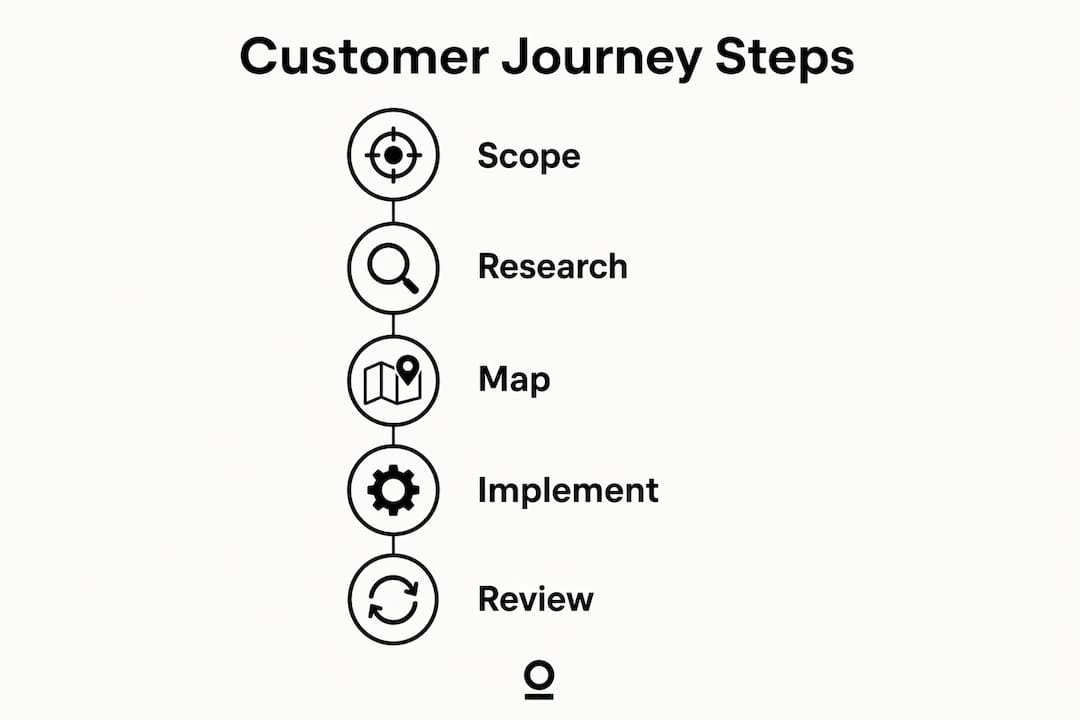
Define your objective. Decide what you want to learn and how you will use the output. Are you mapping a specific transaction or the end-to-end experience? A broad behavioural overview or a granular look at one channel? Clarity here shapes every decision that follows.
Involve the right people. Cross-functional collaboration is not optional. Bring in representatives from every team that touches the customer journey, including those who rarely sit in the same room. This is also the stage to define your customer personas or, in B2B contexts, your buying committee.
Gather real customer data. Interviews, CRM logs, call recordings, surveys, and behavioural analytics all feed the map. Data-driven maps from these sources consistently outperform assumption-driven ones in driving effective change. The research-based map shows what actually happens, not what teams hope is happening.
Visualise touchpoints, emotions, and pain points. Use a grid format with journey stages on the horizontal axis and information layers on the vertical: emotional levels, channels, touchpoints, departments, and supporting systems. Colour-coding emotional highs and lows makes the map readable at a glance.
Analyse and assign ownership. Identify the quick wins and the bigger redesign opportunities. Assign a named owner to each improvement so the map drives action rather than gathering dust.
Step | Key activity | Output |
|---|---|---|
1. Scope | Define objectives and audience segment | Clear brief and map boundaries |
2. Stakeholders | Recruit cross-functional team and define personas | Aligned team and research plan |
3. Research | Interviews, CRM data, surveys, observation | Evidence base for the map |
4. Visualise | Map touchpoints, emotions, channels, pain points | Draft journey map |
5. Analyse | Identify improvements and assign ownership | Prioritised action list |
Pro Tip: Print your map large and stick it on a wall in your team area. A physical artefact that people walk past every day prompts far more discussion and iteration than a slide deck that lives in a shared drive.
Putting journey map insights into practice
The map is only as useful as what you do with it. Start with the faster, cheaper fixes: content changes, navigation improvements, and clearer communications tend to deliver value quickly and build momentum for bigger changes.
Longer-term redesign work needs a different approach. Use the map to show what an improved journey could look like, and let that vision form the basis of a delivery backlog. The GOV.UK Service Manual recommends building an improved journey map that shows the ideal experience designed around what makes sense to users, not what makes sense to the organisation.
Integrate map insights with your existing feedback mechanisms. Net Promoter Score data, post-transaction surveys, and customer service call themes all become more meaningful when you can place them against specific journey stages. That connection between qualitative insight and quantitative signal is where omnichannel customer experience work really starts to pay off.
Avoiding common pitfalls in customer journey mapping
“The research-based journey map should be about what actually happens, not what people would like to happen.” — GOV.UK Design in Government blog
Most journey mapping projects go wrong in one of three ways. The first is internal bias: teams build maps from their own assumptions rather than real user research, and end up seeing only their part of the journey. The second is oversimplification: forcing a complex, cyclical customer experience into a tidy linear diagram that hides the actual problems. The third is treating the map as a finished document rather than a living tool.
Here is how to avoid each one:
Base every map on real customer data. Interviews, observations, and behavioural analytics correct the gap between what teams believe customers do and what customers actually do.
Embrace non-linear journeys. If your customers loop back, deviate, or drop out and return, the map needs to show that honestly.
Keep the map evolving. Static maps in slide decks rarely influence action. A living document, updated as customer behaviour changes, stays relevant and useful.
Use physical maps to break down silos. Large, printed journey maps encourage teams from marketing, sales, and support to confront real user experiences together in a way that a shared document simply does not.
Pro Tip: Run a short “map review” session every quarter. Bring in fresh customer data, challenge assumptions, and update the map before it drifts out of date.
Which tools work best for customer journey mapping?
The right tool depends on how your team works and how complex your journey is. For early-stage, collaborative mapping, a physical wall with sticky notes and printed cards remains one of the most effective formats, particularly for cross-departmental workshops. The GOV.UK experience mapping guidance recommends exactly this approach for its ability to get teams thinking together rather than in isolation.
For digital mapping, whiteboard-style platforms such as Miro and Mural are widely used across UK organisations. They support real-time collaboration, colour-coded layers, and easy sharing. For organisations that need to connect journey maps directly to CRM or analytics data, purpose-built CX platforms offer more structured templates and measurement integration. When planning digital campaigns alongside your mapping work, having a digital map that links to campaign touchpoints makes the connection between strategy and execution much clearer.
Customer journey map examples across industries
Journey maps look different depending on the sector, but the underlying logic is consistent.
Public sector: A UK citizen applying for a benefit experiences a journey that spans weeks, involves multiple departments, and shifts between online and offline channels. The GOV.UK pension journey map, for example, revealed that very few fixed points exist across all users, which led teams to focus on specific life-phase scenarios rather than a single universal journey.
Retail: A customer discovering a brand through social media, visiting the website, abandoning a basket, receiving a follow-up email, and completing a purchase in-store has a journey that crosses at least four channels. Mapping this reveals where the handoffs break down.
B2B services: A buying committee evaluating a software provider might loop through the consideration stage several times over months. A B2B journey map captures each stakeholder’s individual experience alongside the collective decision process.
Healthcare: A patient’s journey from symptom to diagnosis to treatment involves clinical touchpoints, administrative processes, and significant emotional peaks and troughs. Mapping this helps NHS trusts identify where anxiety spikes and where clearer communication would reduce unnecessary contact.
How to connect journey maps with your wider CX strategy
A journey map works best as one layer within a broader customer experience strategy, not as a standalone exercise. Connect it to your Voice of the Customer programme so that survey data, NPS scores, and complaint themes map directly onto specific journey stages. That connection turns abstract scores into specific, fixable problems.
Service blueprints sit alongside journey maps rather than replacing them. Where a journey map shows the customer’s experience, a service blueprint shows the organisational processes that support it. Using both together gives you a complete picture of where the experience breaks down and why.
Brand strategy and journey mapping also reinforce each other. Every touchpoint on a journey map is an opportunity to express your brand consistently. When the emotional arc of the journey aligns with your brand values, customers feel the coherence even if they cannot articulate it.
How do you measure the impact of journey mapping work?
Measurement starts before the map is finished. Define the metrics you expect to move at the scoping stage, whether that is NPS, customer effort score, conversion rate, churn, or resolution time. Without a baseline, you cannot demonstrate change.
Track metrics at the specific journey stages where you made improvements, not just at an overall level. A reduction in call centre volume following a content change on a key web page is a direct signal. An improvement in post-onboarding NPS after redesigning the welcome sequence is another. These stage-level measurements are far more useful than a single aggregate score.
Review the map itself as part of your measurement cycle. If customer behaviour has shifted, the map needs updating before the next round of improvements begins.
Key takeaways
Customer journey mapping delivers its greatest value when it is built on real customer data, kept as a living document, and used to align teams around a shared picture of the experience.
Point | Details |
|---|---|
Base maps on real data | Internal assumptions consistently miss where customers actually drop off or struggle. |
Embrace complexity | Cyclical and non-linear journeys reveal problems that simplified linear maps hide. |
Use physical maps for alignment | Large printed maps get cross-functional teams confronting shared realities together. |
Treat maps as living documents | Static maps in slide decks rarely drive action; regular updates keep them relevant. |
Brands & Co | Brings nearly two decades of empathy-led brand strategy to help organisations build journey maps that connect to real customer experience and brand identity. |
Brands & Co brings the human perspective your journey maps need
Most journey mapping exercises produce a diagram. What they rarely produce is genuine empathy for the customer. That gap is where brand strategy and CX work meet, and it is exactly where Brands & Co operates.
With nearly two decades of experience getting under the skin of clients’ businesses and their customers, Brands & Co builds bespoke brand and CX strategies that go beyond the visual. Whether you need to translate journey map insights into a clearer brand identity, a website that actually reflects how your customers think, or a communications approach that speaks to the right people at the right moment, the studio works with you to make it real. No generic frameworks. No off-the-shelf answers. If you want to see this thinking in action, take a look at the Soul Reformer Club project for a clear example of empathy-led brand work that started with understanding the customer’s experience. Get in touch with Brands & Co to start a conversation about what your customers are actually experiencing.